

Reliable Pharmaceutical CCIT Methods Compared
Container Closure Integrity Testing (CCIT) ensures the sterility and quality of pharmaceutical packaging. Multiple technologies exist, each with different strengths depending on container type, product formulation, and required sensitivity.
In recent years, regulatory guidance such as EU GMP Annex 1 and USP <1207> has pushed the industry toward deterministic CCIT methods, which provide quantitative, reproducible, and objective results.
Among these technologies, laser-based headspace analysis (HSA) has emerged as one of the most practical solutions for pharmaceutical applications because it enables non-destructive testing, repeatable measurements, and compatibility with automated or inline inspection systems.
This guide compares the most widely used CCIT technologies and explains where each method fits best.
Who this guide is for:
This guide is intended for pharmaceutical professionals evaluating container closure integrity testing (CCIT) technologies for sterile packaging systems.
- Quality Control and Analytical Teams
- Packaging and Container Development Engineers
- Pharmaceutical Manufacturing and Process Engineers
- Regulatory and Validation Specialists
- Pharmaceutical Technology and Innovation Groups
What Annex 1 and USP <1207> Expect
Regulatory guidance such as EU GMP Annex 1 and USP <1207> defines the expectations for container closure integrity testing in pharmaceutical packaging. These frameworks do not mandate a single technology but emphasize validated, scientifically justified methods and increasingly favor deterministic approaches.
EU GMP Annex 1
EU GMP Annex 1 does not require one universal CCIT technology, but it is explicit that final container integrity must be verified using validated methods.
For fusion-sealed containers such as:
- Glass ampoules
- BFS units
- Small-volume fusion-sealed containers up to 100 mL
Annex 1 requires 100% integrity testing. It also states that visual inspection is not an acceptable integrity test method for this purpose.
For non-fusion systems, sampling may be acceptable if supported by a scientifically justified sampling plan. Annex 1 also expects integrity validation to consider transport and shipping stress.
USP <1207>
USP <1207> is method-agnostic in principle, but it is built around a risk-based, lifecycle approach to method selection and validation for sterile packaging systems.
USP <1207> clearly supports:
- Method selection based on package and product risk
- Validation of leak test technologies
- Use of objective, reproducible methods
In practice, this means deterministic methods are generally preferred over older probabilistic methods where feasible.
FDA Postion
FDA guidance is aligned with this direction. A properly validated physical, chemical, or microbiological container closure integrity method may support stability protocols, but CCIT does not replace required sterility testing for release.
In practice, this regulatory direction increases the value of deterministic technologies that are objective, reproducible, and suitable for integration into modern pharmaceutical workflows, including automated and inline systems.
Deterministic vs Probabilistic CCIT Methods
Deterministic Methods
Deterministic methods measure a physical parameter such as pressure, gas flow, electrical response, or headspace composition. They are generally:
- More sensitive
- More reproducible
- Less operator dependent
- Better suited for automation
Examples include different variations and applications of laser-based headspace analysis (HSA), vacuum decay, High Voltage Leak Detection (HVLD), helium leak testing, mass extraction.
Probabilistic Methods
Probabilistic methods rely more heavily on challenge conditions, visual interpretation, or biological outcomes. They are typically:
- Less sensitive
- More variable
- More operator dependent
- Less suitable for automation or 100% inspection
Examples include dye ingress and microbial ingress.
Why the Industry Is Moving Toward Deterministic CCIT
Deterministic methods are becoming the standard
Regulators and industry guidance increasingly favor deterministic CCIT technologies because they offer:
- Quantitative results
- Better repeatability
- Less operator dependence
- Higher sensitivity than traditional probabilistic methods
- Stronger suitability for automation and process control
Why this matters in pharmaceutical production
In pharmaceutical manufacturing, the best CCIT methods are not only sensitive. They also need to support:
- Non-destructive inspection
- Repeat testing during stability studies
- Efficient QC workflows
- High-throughput or inline inspection where possible
Where laser-based headspace analysis (HSA) stands out
Laser-based HSA is particularly strong because it addresses several of these needs at the same time. It provides:
- Deterministic, objective measurement
- Non-destructive testing
- Quantitative data
- Suitability for repeated testing on the same sample
- Strong potential for automation and in-line deployment
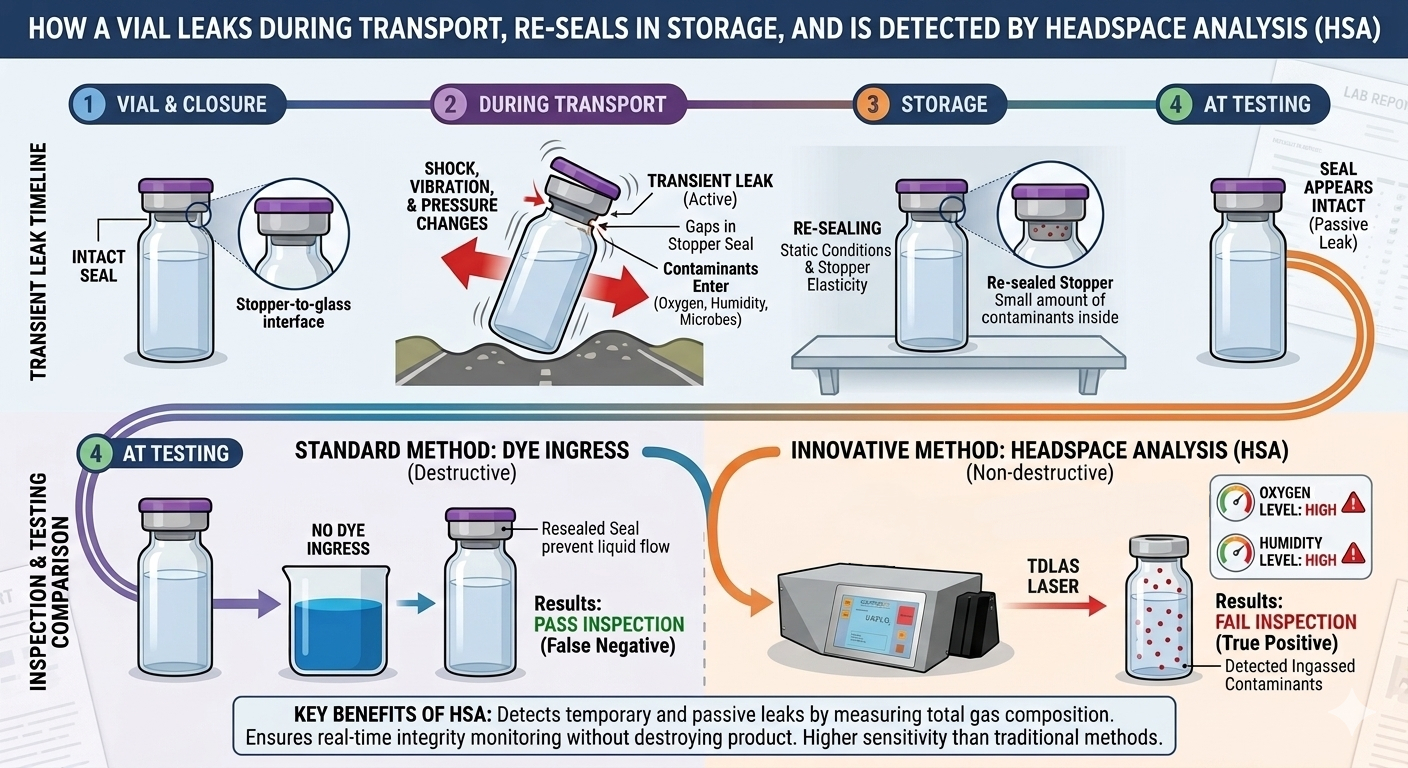
- Ability to detect historic leaks that have resealed.
This makes it one of the most attractive CCIT technologies for pharmaceutical manufacturers seeking a balance between sensitivity, practicality, and production compatibility.
Why Laser-Based HSA is one of the best CCIT solutions for pharmaceuticals
Strong fit for modern pharmaceutical manufacturing
- Non-destructive testing
- Quantitative and objective measurement
- High sensitivity to relevant headspace changes
- Repeated measurement over time
- Compatibility with automated and inline inspection strategies
Particularly valuable where repeated testing matters
- Stability studies
- Oxygen ingress monitoring
- Vacuum retention verification
- Process development
- Investigation of package performance over time
Particularly valuable where in-line inspection matters
- Efficient production workflows
- Reduced reliance on destructive sampling
- More scalable inspection strategies
- Stronger process control in manufacturing
Best fit applications for laser-based HSA
- Vials
- Cartridges
- Syringes
- Lyophilized products
- Oxygen-sensitive products
- Vacuum-sealed systems
And other applications where headspace quality is itself a critical quality attribute.
Detecting "Historic" or Transient Leaks
While most methods only detect a physical hole present at the exact moment of testing, Laser-based HSA is uniquely capable of detecting “historic” leaks.
If a container loses its seal during transit or storage and then reseals itself (a transient leak), pressure-based tests will pass it as “sealed.” However, HSA sees the consequence: it detects the altered gas composition or lost vacuum inside.
- Beyond the “Point-in-Time”: Identifies if a leak ever occurred, even if the container is currently airtight.
- Process Insight: Verifies if the nitrogen overlay or vacuum was successfully maintained from the moment of filling.
- True Quality Assurance: Ensures the internal environment, not just the physical shell, has remained compromised-free throughout the life of the product.
Quick Summary of the Best-Fit Methods for Pharmaceutical Packaging
For parenteral pharmaceutical applications, the most defensible routine CCIT methods today are usually deterministic. The best choice depends on product and packaging format.
Leading deterministic options for parenterals
For pharmaceutical packaging applications, the leading deterministic methods typically include:
- Laser-based HSA for headspace-based integrity monitoring, oxygen ingress, vacuum verification, lyophilized products, and applications where non-destructive and inline testing are priorities
- HVLD for liquid-filled parenterals where conductivity and product characteristics are suitable
- Vacuum decay for broad deterministic coverage across many package formats
- Mass extraction for broad package applicability and production-scale testing
- Helium leak testing where maximum sensitivity is needed during development and validation
7 Pharmaceutical CCIT Methods Compared

Headspace Analysis for Oxygen, HSA-O₂
Type: Deterministic headspace gas analysis by laser absorption
Best fit: Oxygen-sensitive products with measurable headspace oxygen
Learn more
Common use cases
- Oxygen ingress monitoring over stability
- Inert gas headspace verification
- Development and QC for oxygen-sensitive products
Benefits
- Non-destructive
- Quantitative
- Supports repeated measurements on the same sample
- Links package integrity to oxidation risk
Limitations
- Requires measurable headspace and suitable optical access
- Not universal for all container geometries or product types
Regulatory fit
- Annex 1: Good fit where oxygen ingress is the critical failure mode
- USP <1207>: Well aligned as a deterministic headspace method
Headspace Analysis for Water Vapor and Total Pressure, HSA-H₂O
Type: Deterministic headspace gas analysis by laser absorption
Best fit: Lyophilized or vacuum-sealed parenterals
Learn more
Common use cases
- Vacuum verification after lyophilization
- Loss-of-vacuum monitoring during storage
- Repeated stability measurements
Benefits
- Non-destructive
- Directly relevant to vacuum-maintaining systems
- Strong fit for repeat measurement over time
Limitations
- Specialized application
- Depends on suitable water-vapor behavior and headspace conditions
- Not a universal method for liquid-filled systems
Regulatory fit
- Annex 1: Very strong where vacuum maintenance is the key integrity attribute
- USP <1207>: Strong fit as a deterministic headspace approach
Headspace Analysis for Carbon Dioxide, HSA-CO₂
Type: Deterministic headspace gas analysis by laser absorption
Best fit: Media fill inspection, modified headspace studies, and CO2-based process monitoring
Learn more
Common use cases
- CO2 monitoring in media fills
- Ingress or egress studies
- Headspace condition verification
Benefits
- Non-destructive
- Quantitative
- Can be automated
Limitations
- Requires relevant headspace, optical access, and CO2 significance
- Less universal than vacuum decay or HVLD for routine liquid-parenteral CCIT
Regulatory fit
- Annex 1: Acceptable where scientifically justified
- USP <1207>: Consistent with deterministic headspace methodologies
High Voltage Leak Detection (HLVD)
Type: Deterministic electrical method
Best fit: Standard liquid-filled vials, ampoules, cartridges, and prefilled syringes
Learn more
Common use cases
- Routine QC
- In-line inspection
- Detection of pinholes, cracks, stopper leaks, plunger leaks, and crimp-related breaches
Benefits
- Non-destructive
- Highly sensitive
- Well suited to liquid parenterals
- Good fit for high-throughput environments
Limitations
- Requires a suitable conductive or electrically responsive product-package system
- Not suitable for dry products or some non-conductive systems
- Product and container tuning is required
- Not suitable for high-alcohol content products due to safety concerns regarding flammability
Regulatory fit
- Annex 1: Good for validated deterministic testing of liquid-filled parenterals
- USP <1207>: Aligned as a deterministic technology
Vacuum Decay
Type: Deterministic
Best fit: Standard vials, ampoules, syringes, bottles, BFS strips, IV bags, and other suitable rigid or flexible nonporous packages
Learn more
Common use cases
- Routine laboratory CCIT
- Stability testing
- At-line or automated inspection
- General-purpose deterministic testing for parenterals
Benefits
- Objective and quantitative
- Non-destructive
- Broad package applicability
- Strong regulatory acceptance
Limitations
- Performance depends on package-product interaction and fixture design
- Leak behavior may be affected by product properties
- Some oily, viscous, lyophilized, or protein-based products may be better served by another method
Regulatory fit
- Annex 1: Strong fit for validated sampling or automated inspection programs. Can support 100% testing when fully validated
- USP <1207>: Well aligned and widely accepted
Mass Extraction
Type: Deterministic vacuum-based
Best fit: Broad range of packages where airflow through a leak can be measured in a vacuum chamber
Learn more
Common use cases
- Routine QC
- Stability studies
- Offline and inline production-scale testing
Benefits
- Quantitative
- Broad package-shape applicability
- Non-destructive
- Good fit for production-scale use
Limitations
- Requires package-specific development
- Headspace and product attributes still influence optimization
- Less familiar in some pharma teams than vacuum decay or HVLD
Regulatory fit
- Annex 1: Good fit as a validated deterministic method
- USP <1207>: Good fit and commonly seen as a preferred deterministic option
Helium Leak Testing, Inside-out
Type: Deterministic helium mass spectrometry
Best fit: Development, package characterization, highly sensitive leak-rate studies
Learn more
Common use cases
- Method development
- MALL studies
- Package comparison
- Root-cause investigations
Benefits
- Very high sensitivity
- Quantitative leak-rate output
- Strong for defining leak limits and correlating leakage to risk
Limitations
- Often destructive
- Complex helium handling
- Lower throughput than many routine production methods
Regulatory fit
- Annex 1: Excellent for sensitive deterministic validation work
- USP <1207>: Very strong fit, especially for package integrity characterization
Helium Leak Testing, Outside-in
Type: Deterministic helium tracer method
Best fit: Fixture-based testing of seals, ports, syringes, induction seals, and selected plastic systems
Learn more
Common use cases
- Localized leak-path testing
- Applications where internal helium filling is impractical
- Some faster fixture-based testing systems
Benefits
- Avoids internal tracer gas preparation
- Can be fast
- Useful for localized seal-path evaluation
Limitations
- More application-specific
- More fixture dependent
- Validation rationale must be especially clear
Regulatory fit
- Annex 1: Acceptable if fully validated for the package and leak mechanism
- USP <1207>: Can fit helium tracer methodology, but requires package-specific justification
Pressure Decay
Type: Deterministic physical test
Best fit: Flexible non-porous packages and selected rigid containers in package-specific systems
Learn more
Common use cases
- Flexible bags and pouches
- Some rigid containers with differential-pressure or specialized fixture designs
Benefits
- Fast
- Quantitative
- Non-destructive
- Useful where chamber pressurization is preferable to evacuation
Limitations
- Less standardized for rigid parenteral formats
- Sensitivity can be lower than helium and some advanced methods
- Sensitive to temperature and package expansion behavior
Regulatory fit
- Annex 1: Acceptable when validated and justified
- USP <1207>: Fits deterministic expectations, but package suitability must be demonstrated clearly
Optical Emission Spectroscopy, O.E.S.
Type: Deterministic vacuum-based gas analysis
Best fit: Sensitive leak detection where natural headspace gases can be analyzed
Learn more
Common use cases
- Fine and gross leak detection
- Moisture-sensitive products
- Development through production, depending on platform design
Benefits
- No tracer gas required
- High sensitivity
- Can detect gross and fine leaks in one run
- Scalable to higher throughput
Limitations
- More specialized
- Less familiar than vacuum decay or HVLD
- Strong package and headspace suitability assessment is needed
Regulatory fit
- Annex 1: Acceptable as a validated deterministic method
- USP <1207>: Consistent with deterministic method selection, but usually needs stronger technical justification
Dye ingress
Type: Probabilistic
Best fit: Development work, comparative studies, legacy validation packages, and some troubleshooting
Learn more
Common use cases
- Legacy CCIT programs with historical acceptance criteria
- Gross to moderate leak challenge studies
- Development work using visual or UV/Vis tracer studies
Benefits
- Simple concept
- Low equipment barrier
- Useful as a physical limit test when carefully designed
Limitations
- Operator dependent
- Lower sensitivity than deterministic methods
- Often destructive
- Visual interpretation can be subjective
- Some products are unsuitable for UV/Vis evaluation
Regulatory fit
- Annex 1: Can support a validated integrity strategy, but not suitable for 100% integrity testing of fusion-sealed small containers
- USP <1207>: Recognized as a probabilistic method, acceptable when justified, but not preferred where deterministic options are feasible
Microbial Ingress
Type: Probabilistic microbiological challenge
Best fit: Microbial barrier studies, correlation work, high-risk qualification studies
Learn more
Common use cases
- Container closure qualification
- Bridging studies between physical leak tests and sterility rationale
- Legacy microbiological challenge programs
Benefits
- Directly relevant to microbial ingress risk
- Useful for barrier function demonstration
Limitations
- Slow
- Destructive
- Labor intensive
- High variability
- Poor fit for routine or 100% testing
Regulatory fit
- Annex 1: Acceptable only as part of a justified validation strategy
- USP <1207>: Recognized, but generally not preferred for routine use over deterministic methods
Which CCIT Method Is Best for Your Pharmaceutical Application?
No single container closure integrity testing method is optimal for every pharmaceutical product. The most appropriate technology depends on several factors, including:
- Container format
- Product formulation
- Required sensitivity
- Headspace characteristics
- Whether testing must be destructive or non-destructive
- Whether inline or automated inspection is required
For most pharmaceutical packaging systems, deterministic CCIT technologies provide the strongest combination of sensitivity, repeatability, and regulatory alignment. The sections below outline which methods typically provide the best fit for common pharmaceutical applications.
Liquid-Filled Parenterals (Vials, Syringes, Ampoules, Cartridges)
Liquid-filled parenteral products represent one of the most common sterile packaging formats. In these systems, the most widely used deterministic CCIT technologies include:
Best-fit methods:
- Laser-based headspace analysis (HSA): Especially valuable when monitoring oxygen ingress or headspace condition is important. Non-destructive testing also enables repeated measurements during stability studies.
- High Voltage Leak Detection (HVLD): Highly effective for detecting microleaks in liquid-filled containers. Particularly suitable for high-speed inline inspection where the product conductivity supports the method.
- Vacuum decay: A widely adopted deterministic method that provides reliable detection for many rigid container formats. Often used for QC and stability testing.
- Mass extraction: A deterministic vacuum-based approach suitable for a broad range of container types, particularly in laboratory and production-scale environments.
- Helium leak testing: Often used during development or validation when extremely high sensitivity is required to establish leak limits.
Key takeaway:
For liquid parenterals, HVLD and vacuum decay along HSA are common routine methods, while laser-based HSA provides additional value where headspace condition or repeated non-destructive testing is important.
Lyophilized or Vacuum-Sealed Products
Lyophilized pharmaceuticals rely on maintaining vacuum conditions inside the container. In these systems, CCIT methods that directly measure headspace pressure or gas behavior are particularly valuable.
Best-fit methods:
- Laser-based HSA (HSA-H₂O): One of the strongest non-destructive solutions for verifying vacuum retention in lyophilized vials. Allows repeated measurements during stability studies.
- Helium leak testing: Often used during development or validation when defining leakage limits or studying package integrity.
- Vacuum-based deterministic methods: Selected vacuum decay or similar technologies may also be used depending on the container configuration.
Key takeaway
For lyophilized pharmaceuticals, laser-based headspace analysis is often one of the most effective non-destructive solutions for monitoring vacuum integrity over time.
Oxygen-Sensitive Pharmaceutical Products
Some biologics and small-molecule drugs are sensitive to oxygen exposure. In these cases, container closure integrity is closely linked to oxygen ingress and headspace composition.
Best-fit methods:
- Laser-based HSA (HSA-O2): A deterministic method that directly measures headspace oxygen concentration. Particularly valuable for monitoring oxygen ingress during stability testing.
- Other headspace analysis approaches: Depending on the process, CO₂ or other headspace gases may also be monitored.
Key takeaway
When oxidation risk is a key product concern, laser-based headspace analysis provides one of the most direct ways to link CCIT performance to product quality and shelf-life.
Method Development and Package Characterization
During development, manufacturers often need to determine maximum allowable leakage limits (MALL) and understand how package defects influence container performance.
- Best-fit methods:
- Helium leak testing: Often considered the analytical reference method for high-sensitivity leak detection.
- Laser-based headspace analysis: Useful for studying headspace gas behavior and ingress over time.
- Dye ingress: Sometimes used for legacy comparison or early development screening.
- Microbial ingress testing: Used when microbial barrier performance must be demonstrated.
Key takeaway
Development studies often use multiple complementary methods, combining highly sensitive analytical techniques with practical integrity tests used later in production.
Bottom-Line Compliance View
For pharmaceutical CCIT, the industry direction is clear. Deterministic methods are increasingly preferred because they provide more reliable and reproducible results than legacy probabilistic tests.
Within that shift, laser-based HSA stands out as one of the strongest solutions. Its combination of non-destructive testing, quantitative measurement, repeatability, and inline potential makes it especially well suited to modern pharmaceutical manufacturing and stability workflows.
Other deterministic methods such as HVLD, vacuum decay, helium leak testing, and mass extraction remain important and in many cases complementary. But where headspace analysis is relevant, laser-based HSA should be positioned as a leading method rather than a niche alternative.
Looking for the right CCIT method for your pharmaceutical packaging?
For applications where non-destructive testing, repeat measurements, and inline capability are important, laser-based headspace analysis is often one of the strongest solutions to evaluate.
Talk to Gasporox about how laser-based HSA fits your container format, product type, and integrity requirements.
Frequently Asked Questions
What is container closure integrity testing (CCIT)?
Container Closure Integrity Testing (CCIT) refers to a series of tests used to ensure that a drug's packaging (like vials, syringes, or IV bags) is perfectly sealed wit the purpose to prevent bacteria, air, or moisture from entering the container, which could spoil the medicine or harm the patient
What deterministic CCIT methods are commonly used?
Common deterministic CCIT methods include laser-based headspace analysis, vacuum decay, high voltage leak detection, helium leak testing, and mass extraction.
Does Annex 1 require one specific CCIT method?
No. Annex 1 does not mandate a specific CCIT technology (such as vacuum decay or high voltage leak detection). Instead, it requires that the chosen method is scientifically valid and sensitive enough to detect the specific leak sizes that could compromise the product’s sterility.
Are deterministic methods preferred over probabilistic methods?
Yes. While both methods are technically recognized, deterministic methods are the industry standard and are strongly preferred by regulators, as clearly outlined in USP <1207>.
The industry has moved away from probabilistic methods (like the blue dye ingress test or microbial immersion) because they are often destructive, time-consuming, and prone to human error. Deterministic methods (such as Headspace Analysis, High Voltage Leak Detection, or Vacuum Decay) offer several critical advantages
Is dye ingress still acceptable in pharmaceuticals?
Yes, but with significant caveats. Dye ingress is still used in specific scenarios—such as early-stage formulation development, packaging feasibility studies, or for specific "legacy" products where the method was originally validated.
However, for routine commercial production, its use is strictly scrutinized. If you choose dye ingress over a deterministic method, you must be prepared to provide: scientific justification, validation of sensitivity, and risk management.
What is the best CCIT method for sterile injectable products?
There is no universal "best" method, as the choice depends on the drug's physical properties and packaging. However, for high-value sterile injectables, especially those that are lyophilized (freeze-dried) or oxygen-sensitive, Laser-based Headspace Analysis (HSA) is often the superior choice.
While methods like Vacuum Decay and HVLD are excellent for detecting active physical leaks, Headspace Analysis offers a unique "historical" perspective that no other method can provide
