

GPX1500 Vial
Instrument for quality inspection and CCIT of pharmaceutical vials and ampoules.
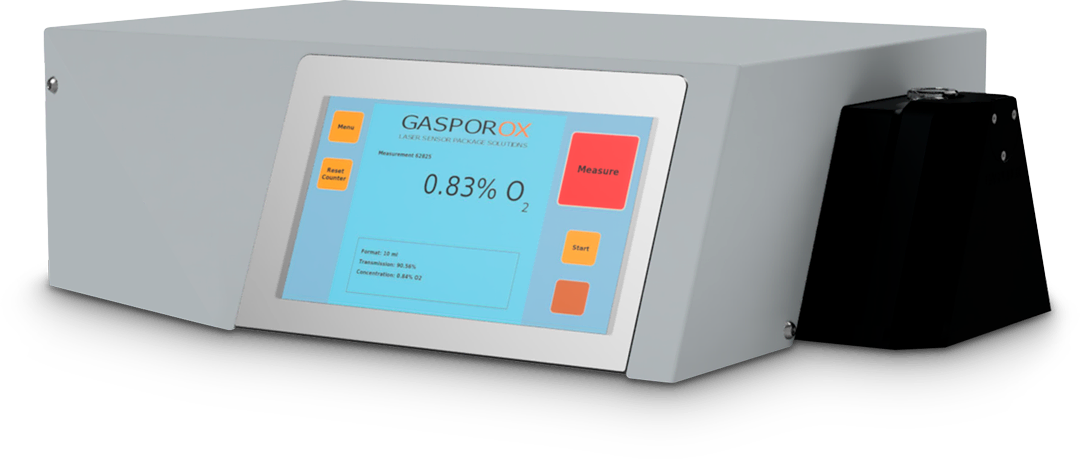
fast and accurate
The GPX1500 Vial is a compact, non-destructive headspace analyser series for precise oxygen, carbon dioxide, pressure measurements in sealed pharmaceutical containers and parenteral packaging. Designed specifically for vials and ampoules, it delivers fast, accurate, and non-intrusive testing to ensure container closure integrity (CCIT) and product quality through laser-based headspace analysis (HSA).
How does it work?
The GPX1500 Vial is a compact, user-friendly tabletop instrument designed for non-destructive headspace analysis (HSA) and container closure integrity testing (CCIT). It is available in three sensor configurations for measuring oxygen (O₂), carbon dioxide (CO₂), or total pressure (H₂O) in pharmaceutical vials and ampoules.
To perform a test, the container is placed in a dedicated format holder. A precise laser beam then passes through the headspace of the sealed vial or ampoule, analyzing the internal gas concentration using Tunable Diode Laser Absorption Spectroscopy (TDLAS). Results are displayed instantly on-screen, enabling fast, accurate, and non-intrusive quality control without the need for sample preparation or destruction.
Headspace based integrity testing and method distinction
The GPX1500 Vial platform is based on laser based headspace analysis (HSA), enabling non-destructive assessment of container integrity and packaging quality by measuring the actual gas conditions inside sealed pharmaceutical containers.
Depending on the application, integrity and process performance can be evaluated by measuring oxygen (O₂), carbon dioxide (CO₂), or total internal pressure (H₂O) in the vial headspace. This approach differs from vacuum based CCIT methods, which infer integrity by applying external pressure changes to the container.
Integrity and process verification via headspace gas measurement
By directly measuring internal headspace conditions, the GPX1500 Vial supports multiple integrity and quality strategies:
Oxygen (O₂) measurement
Oxygen measurement is primarily used to:
- Measure residual oxygen after filling and closure
- Validate filling, stoppering, and sealing processes
- Detect oxygen ingress in oxygen sensitive products
Changes in oxygen concentration over time can also be used as an indicator of container closure integrity for products where oxygen exposure is critical to stability.
Carbon dioxide (CO₂) measurement
Carbon dioxide measurement is commonly used in CO₂ bombing applications, where containers are exposed to elevated CO₂ levels in a pressure chamber. This enables:
- Detection of leaks through CO₂ ingress
- Integrity testing based on changes in internal CO₂ concentration
- Non-destructive leak testing using tracer gas principles
This approach is suitable for containers where CO₂ is not part of the normal headspace composition.
Pressure (H₂O) measurement
Pressure measurement determines the total internal headspace pressure and is used to:
- Verify the presence of vacuum
- Detect pressure changes indicating loss of integrity
- Monitor vacuum maintenance over time
This is particularly relevant for lyophilized products and other applications where vacuum conditions are a defined quality attribute.
Contact Us
Want a quote or need more details about this product? Our team is ready to help.
Typical applications for the GPX1500 Vial
The GPX1500 Vial is used across pharmaceutical development and manufacturing for non-destructive headspace analysis and container closure integrity testing, including:
- Residual oxygen measurement to validate filling and closure processes
- Leak testing of oxygen sensitive products
- CO₂ tracer gas leak testing using CO₂ bombing
- Verification of vacuum presence and maintenance in lyophilized vials
- Stability studies and shelf life monitoring
- At-line and laboratory quality control testing
Available Variations
- GPX1500 Vial O₂ – Measures oxygen (O₂) concentration in the headspace of sealed pharmaceutical containers. Ideal for oxygen-sensitive products requiring headspace gas analysis (HSA) and container closure integrity testing (CCIT).
- GPX1500 Vial CO₂ – Accurately measures carbon dioxide (CO₂) levels in the headspace, supporting quality control of products packaged in CO₂-modified atmospheres.
- GPX1500 Vial H₂O – Measures total internal pressure (in the range of 80 to 1050 mbar), offering a non-destructive way to assess pressure buildup or leakage in sealed containers.
Available Add-ons
- Receipt printer – An integrated printer add-on automatically generates a complete, traceable receipt of each measurement, including all critical test parameters and results, to support documentation, compliance, and quality assurance workflows.
Distinction from vacuum based CCIT methods
Headspace based integrity testing assesses container integrity by measuring the internal headspace gas conditions using laser absorption spectroscopy. The measurement itself is non-destructive and the detection principle is based on internal headspace gas measurement rather than external pressure decay.
Depending on the test strategy, containers may be exposed to defined external environments, such as CO₂ bombing in a pressure chamber, to promote tracer gas ingress prior to measurement. Integrity is then evaluated by analyzing changes in the internal headspace composition.
In contrast, vacuum based CCIT methods apply external pressure changes and evaluate system response to infer container integrity. This distinction is important when:
- The internal gas composition or pressure is a critical quality attribute
- Validation of filling and closure processes is required
- Repeated, non-destructive testing of the same container is needed
Regulatory relevance
Headspace based measurements support regulatory expectations for container closure integrity testing, including:
- Residual oxygen control and monitoring
- Tracer gas based leak testing approaches
- Verification of maintained vacuum conditions, as referenced in EU GMP Annex 1

Easy Setup, Plug-and-Play Operation
The GPX1500 Vial is designed for rapid deployment and ease of use. With its intuitive interface and clear user manual, setup takes just minutes. From unboxing to performing your first headspace gas analysis (HSA) or container closure integrity test (CCIT), the process is simple.
No complex calibration or installation is required, making it an ideal solution for laboratories, QA departments, and production environments seeking a fast, reliable, non-destructive testing tool.
Support and Optimization
Every Gasporox instrument includes complete setup support. Our team works closely with you to ensure the instrument is optimized for your specific product, container, and setup.
We are committed to helping you achieve the best possible performance across your entire inspection process.
Key Features and Technical Highlights
- Non-destructive headspace gas analysis (HSA) for pharmaceutical vials and ampoules.
- Calibration-free and parameter-free operation for easy setup and repeatable results.
- Deterministic testing method compliant with USP <1207> standards.
- Compatible with ISO tubular vials (2R to 100R), moulded vials (16 mm to 49 mm), and ampoules (1–30 mL).
- Suitable for both liquid and solid pharmaceutical products.
- No need for nitrogen or sample preparation.
- Ideal for at-line, storage, or laboratory container closure integrity testing (CCIT).

Technology
The GPX1500 Vial instruments are built on more than 25 years of development and refinement in industrial laser-based gas measurement with roots in research at the Lund University Laser Centre. The system uses Tunable Diode Laser Absorption Spectroscopy (TDLAS), a highly reliable and precise method for non-destructive headspace gas analysis.
Developed by Gasporox in collaboration with its technology partners, this laser sensor technology is widely used in demanding industries such as pharmaceuticals, petrochemicals, and energy.
Gasporox’s laser-based headspace analysis has been successfully deployed for over a decade in pharmaceutical manufacturing. It is integrated into fully automated inspection systems and benchtop instruments for 100% in-line and laboratory testing of vials, ampoules, and other parenteral packaging formats. The performance and robustness of the system have been validated through extensive real-world use.
Explore More
VialArch™
Sensor module for integration in-line HSA and CCIT.
GPX1500 Film Pharma
Instrument for HSA and CCIT of flexible pharmaceutical packaging.
Vial Inspection
Lyophilized vial inspection with the GPX1500 Vial instrument.
